October 11th, 2011
Geekdad at WIRED asks, “Is 3D in Classrooms Just a Gimmick?”
The post includes a video touting new 3D technology that will change your classroom forever. The video claims that 3D technology is the interactive tool that will improve behavior, increase attention, raise test scores, gets students working together, and create their love for learning.
What did I see? Dark classrooms full of students watching a teacher lecture.

They could be sleeping behind those dark glasses.
The video references student engagement seven times but if recall and remembering are your evidence for engagement, why even bother integrating new technology? We can do that with any old chalkboard, worksheet, or textbook.
August 9th, 2011
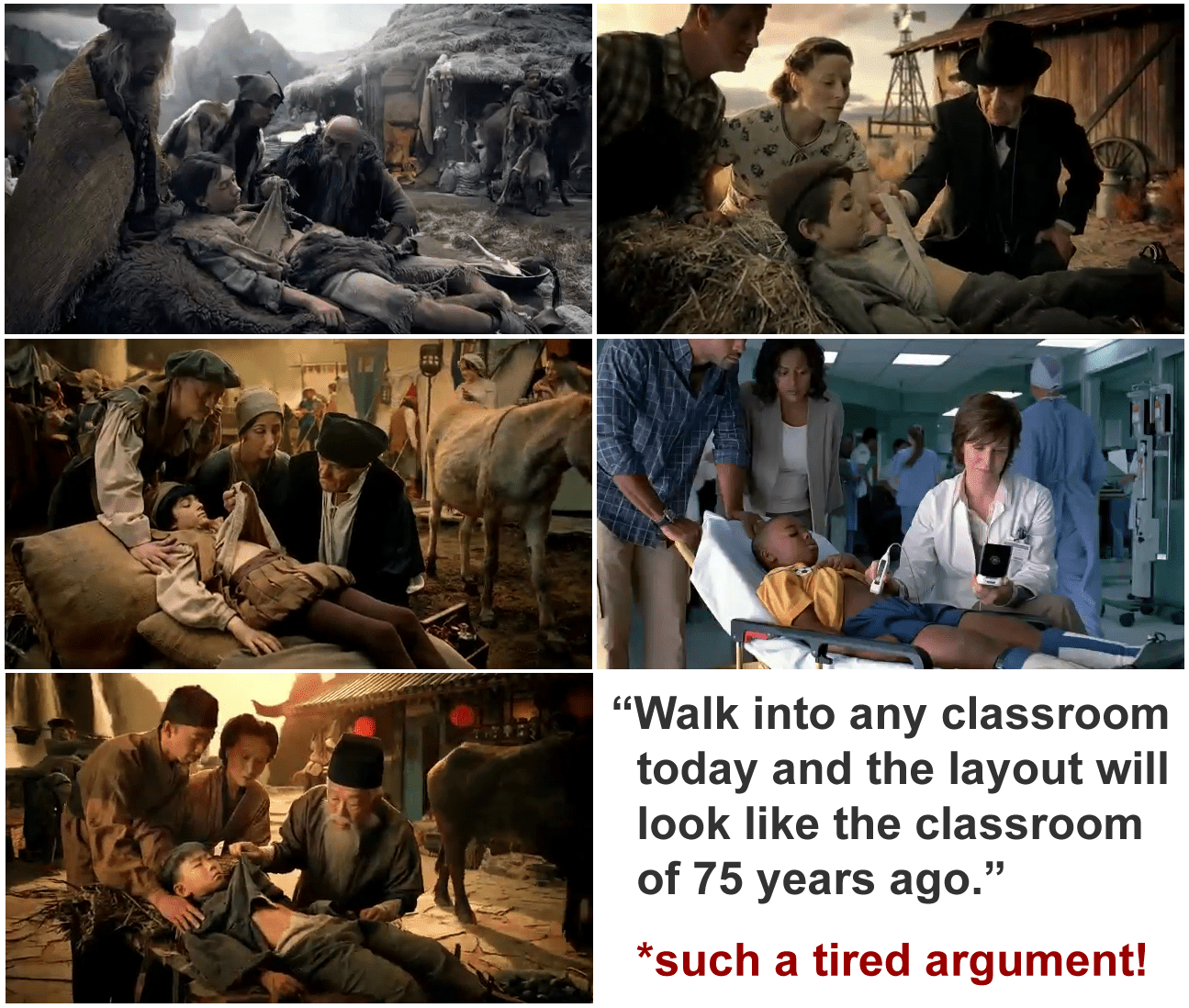
The complaint goes something like this, “Walk into any classroom and it will look a lot like it did 75 years ago.” What does that mean? Bridges look a lot like they did 75 years ago too. The comment is getting as old as the photos of single room classroom critics show while they make it.

Read on…
March 29th, 2011
Here’s my response to all the “bad teacher” claims out there. Find your career.

December 10th, 2010

Old School
Take a look at this week’s cover of Newsweek which featured an article by Michelle Rhee. Rhee, former chancellor of schools in Washington, D.C., writes about the need for school reform nationwide. Yet, there she sits on newsstands throughout the country in a staged but dated view of the classroom.
If I asked you to image heath care reform, what pictures would you conjure up in your mind? Is it a nurse in an all white uniform sporting the white nurse’s cap? Would your nurse be standing in front of a 1940s era operating table?
How about transportation reform? Do you think of a family getting into a 1957 Chevy Bel Air?
Would you imagine energy reform with the coal dusted faces of miners? I doubt any of these images come to mind.
Yet we continue to depict education with images of old-time desks, rundown chalkboards, and a stack of weathered books.
This does nothing to show Americans the new challenges our schools face. These images only teach the public that school is just like it was when they were there.
It cements the idea that “what was good enough for students in my day is good enough for students today.”
April 28th, 2008
I love tumblr.com. It’s such an easy-to-use site for sharing things that you find online. So I was disappointed when my school’s web filter started blocking the site.
I can see why our filter has tumblr on its blacklist; tumblr will let you post anything to their site. Students could use tumblr to chat or view inappropriate material.
But we’re not talking about students; we’re talking about me- the teacher.
Our schools roll clips like Did You Know Shift Happens and use terms like flat-world during staff meetings. Yet, they can’t come up with a process to filter teachers that is different from the one they use for students? In one breath it’s, “prepare our students for the 21st century” and in the next breath its, “just don’t do it on a school computer.”
Andy Carvin at PBS’s learning.now put it best when he wrote:
“…for educators who aren’t trusted to use their professional judgment, an important opportunity to teach their students about 21st century citizenship is being squandered.”
However, ranting usually doesn’t get me anywhere (I often feel better though). This time I decided to take matters into my own hands.
Using tumblr’s API and some php scripting I created my own page that can post to tumblr. Since my all the work is done from an approved site, my posts sneak right past the web filter.
I know it’s a small victory but it felt good to gain back some control for a change. (By the way, here is the script if you’d like to use it on your own web site.)
December 17th, 2007
Take a trip back in time in the archives of Google News and you can find all sorts of papers, books and headlines with the following themes about education:
- education needs to be more relevant to life
- we need to foster more creativity in the classroom
- we’re failing to teach our students technology skills
- students aren’t asked to think critically
- the U.S. will fall behind because of our education
- student learning needs to be more hands-on
Sound familiar? Talking about the future of education seems like a national pasttime that often predicts gloom and doom scenarios.
The craze for the past five years has been the idea of teaching 21st century skills. Many people have made a career by talking and writing about these new skills. But take a look at them. Is there really anything new here? The Partnership for 21st Century Skills lists media literacy, critical thinking, creativity, collaboration, and civic literacy as just a few 21st century skills that will “…align classroom environments with real world environments.”
But haven’t these skills always been taught in school? The only new thing on the list seems to be global awareness. However, this topic has been misrepresented with nationalistic chatter that tried to scare every teacher and student with images of construction companies in China and India.
I don’t think that we should ever stop stressing the skills that are now being called 21st century skills. I just find it insulting to consider that these skills are new. This is an insult to all the excellent educators who have made the U.S. what it is today.
The fear mongering also needs to stop. We are not going to motivate our students with a laundry list of over-hyped statistics.
The best way to improve education is to improve the teacher in the classroom. Instead of providing examples of what should be done, show us the real thing. Join a professional organization and present lessons that worked in the classroom. Get on a social network (like Twitter or Facebook) and share a successful activity.
Let’s make showing off our finest teachers, and more importantly their work, the real 21st century skill.